
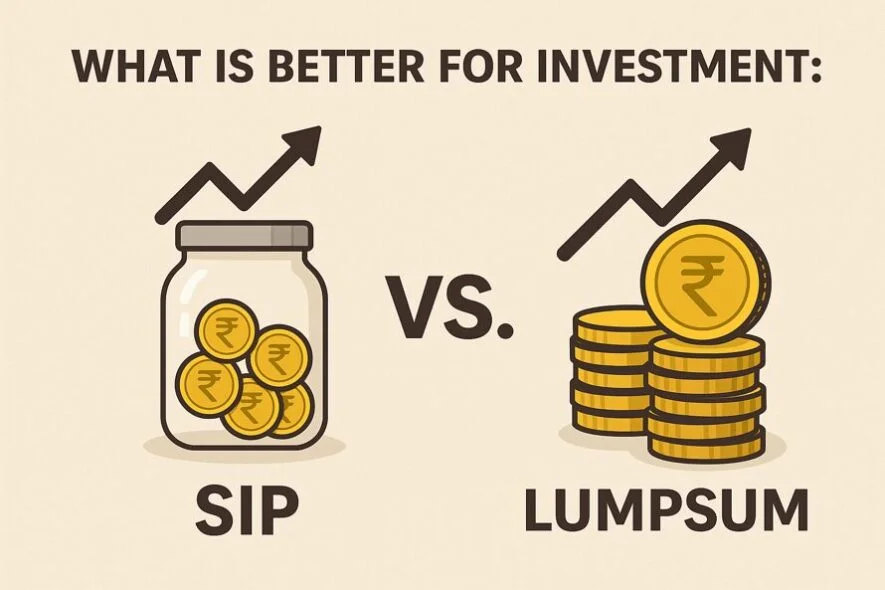
Quick Answer: For most salaried investors in India, SIP (Systematic Investment Plan) is the better choice — it removes the need to time the market, builds investing discipline through automatic monthly contributions, and averages out your purchase cost over market cycles. Lumpsum investing can give higher returns than SIP if you invest at a market low, but consistently timing market lows is nearly impossible even for professionals. For investors who receive a large one-time amount (bonus, inheritance, property sale proceeds), investing it in tranches over 6–12 months through a Systematic Transfer Plan (STP) combines the benefits of both approaches.
What Is SIP? What Is Lumpsum? (The Basics)
SIP — Systematic Investment Plan
A SIP is an instruction to your mutual fund to automatically debit a fixed amount from your bank account every month and invest it in a chosen fund. You set it up once and it runs automatically — ₹1,000, ₹5,000, ₹50,000, whatever amount you choose, on a fixed date every month.
SIP does not guarantee returns. It does not protect you from market falls. What it does is ensure you invest consistently — regardless of whether markets are high, low, or volatile — and that each monthly investment buys units at whatever the price is that day.
Lumpsum
A lumpsum investment means putting a large amount of money into a mutual fund in a single transaction. You buy units at the NAV (Net Asset Value) on that specific day. Your entire investment is immediately exposed to the market — it rises and falls with every market movement from day one.
The returns on a lumpsum investment depend heavily on when you invested. Someone who invested a lumpsum in March 2020 (COVID crash bottom) saw extraordinary returns. Someone who invested a lumpsum in January 2008 (pre-global financial crisis peak) waited years to just break even.
How SIP Works — The Rupee Cost Averaging Advantage
The core benefit of SIP is rupee cost averaging — a mechanism that naturally lowers your average cost per unit over time.
Here is how it works:
When markets are high, your monthly SIP amount buys fewer units (because each unit costs more). When markets are low, your monthly SIP amount buys more units (because each unit costs less).
Over time, this averaging means your effective cost per unit is lower than the average NAV over the period — which means you need a smaller price increase to be in profit.
Rupee Cost Averaging — Illustrated
Imagine a ₹5,000/month SIP over 6 months in a fund with fluctuating NAV:
Month | NAV (₹) | Amount Invested (₹) | Units Purchased |
Month 1 | 100 | 5,000 | 50.00 |
Month 2 | 80 | 5,000 | 62.50 |
Month 3 | 70 | 5,000 | 71.43 |
Month 4 | 90 | 5,000 | 55.56 |
Month 5 | 110 | 5,000 | 45.45 |
Month 6 | 120 | 5,000 | 41.67 |
Total | ₹30,000 | 326.61 units |
Average NAV over period: (100+80+70+90+110+120) ÷ 6 = ₹95
Effective cost per unit via SIP: ₹30,000 ÷ 326.61 = ₹91.85
The SIP investor’s average cost (₹91.85) is lower than the simple average NAV (₹95) — purely because more units were bought when the price was low. At Month 6 NAV of ₹120, the SIP investor has a profit of ₹9,193 (30.6%) vs a lumpsum investor who invested ₹30,000 at Month 1 (₹100 NAV) and has a profit of ₹6,000 (20%).
In this scenario, SIP won. But this is not always the case — which brings us to the lumpsum side of the story.
When Lumpsum Beats SIP — The Case for Timing
Here is the scenario where lumpsum wins decisively:
Scenario: Nifty 50 is at 16,000 in June 2022 (a significant correction — down ~15% from peak). Two investors each have ₹6 lakh to invest.
Investor A (Lumpsum): Invests entire ₹6 lakh in June 2022.
Investor B (SIP): Invests ₹50,000/month for 12 months.
By June 2024, with Nifty at approximately 23,500:
- Investor A’s ₹6 lakh has grown to approximately ₹8.8 lakh (CAGR ~21%)
- Investor B’s ₹6 lakh (invested over 12 months) has grown to approximately ₹7.6 lakh — because the later SIP instalments were invested at higher NAVs
Lumpsum won here — because the investor invested near a market low and the market rose consistently thereafter.
The problem: How do you know in real time that June 2022 was a low? In June 2022, every financial news headline was about global inflation, Fed rate hikes, and fears of a prolonged bear market. It didn’t feel like a buying opportunity — it felt like the market might fall further.
This is why consistently timing the market is so difficult. In hindsight, the right time is always obvious. In real time, it almost never is.
SIP vs Lumpsum — Historical Data From Indian Markets
Let us look at what the data actually shows across multiple time periods.
Rolling 10-Year SIP vs Lumpsum Returns (Nifty 50, Illustrative)
Investment Start | 10-Year SIP CAGR | 10-Year Lumpsum CAGR | Winner |
Jan 2004 (bull market start) | ~14% | ~17% | Lumpsum |
Jan 2008 (pre-crash peak) | ~12% | ~8% | SIP |
Jan 2009 (post-crash bottom) | ~11% | ~19% | Lumpsum |
Jan 2013 (sideways market) | ~13% | ~12% | SIP |
Jan 2016 (correction year) | ~13% | ~14% | Lumpsum |
Jan 2020 (pre-COVID) | ~14% | ~11% | SIP |
Pattern: Lumpsum wins when you invest at or near a market low. SIP wins or stays competitive when you invest at a market high or in a volatile/sideways market. Since most investors cannot reliably identify market lows in advance, SIP provides more consistent outcomes across entry points.
The Key Insight From the Data
Over long periods (10+ years), both SIP and lumpsum in a quality equity fund tend to deliver good returns. The difference in final corpus is often less dramatic than people expect. What SIP truly protects against is the catastrophic scenario — investing a lumpsum right before a major correction and watching years of savings erode.
SIP vs Lumpsum — Head to Head Comparison
Feature | SIP | Lumpsum |
Capital required | Small (as low as ₹500/month) | Large (entire amount at once) |
Market timing needed | No | Yes (for optimal returns) |
Rupee cost averaging | Yes | No |
Discipline required | Low (automated) | High (must not panic sell) |
Best returns scenario | Volatile or declining markets | Steadily rising markets from entry |
Worst returns scenario | Consistently rising market (misses early gains) | Investing at a market peak |
Risk for retail investor | Lower (spread over time) | Higher (full exposure from day one) |
Suitable for | Regular income earners | Recipients of bonuses, windfall, inheritance |
Flexibility | High (pause, increase, decrease anytime) | Low (all in at once) |
Psychological ease | High (small amounts feel less risky) | Low (watching large amount fluctuate is stressful) |
The Third Option — Systematic Transfer Plan (STP)
When you have a large lumpsum to invest but don’t want the full market-timing risk of a one-day lumpsum investment, the Systematic Transfer Plan (STP) is the answer.
How STP Works
- Park the entire lumpsum in a liquid fund or overnight fund (very low risk, ~6.5%–7% return while it waits)
- Set up an automatic transfer of a fixed amount every week or month from the liquid fund into your chosen equity fund
- The equity fund receives systematic investments — similar to a SIP — while the remaining amount earns better-than-savings-account returns in the liquid fund
Example: Meera receives a ₹12 lakh bonus in April. She wants to invest in the Nifty 50 Index Fund but is nervous about investing everything at a market high.
- She parks ₹12 lakh in an SBI Liquid Fund
- She sets up a ₹1 lakh/month STP into an SBI Nifty 50 Index Fund
- Over 12 months, ₹12 lakh moves from the liquid fund to the equity fund in equal monthly transfers
- The remaining liquid fund balance earns ~7% while it waits
Result: Meera gets rupee cost averaging on her equity investment, earns returns on the waiting balance, and avoids the psychological stress of watching ₹12 lakh fluctuate from day one.
STP is the recommended approach for large one-time amounts. It is available on all major platforms — Groww, Zerodha Coin, MF Central — and takes 5 minutes to set up.
When to Choose SIP — Specific Situations
✅ You have a regular monthly salary SIP is purpose-built for salaried investors. Align your SIP date with your salary credit date — the investment happens automatically before you have a chance to spend it.
✅ You are investing for the first time Starting with a small SIP (₹1,000–₹2,000/month) removes the anxiety of committing a large amount to a market you don’t yet understand. You can increase the SIP as your confidence and income grow.
✅ Markets are at all-time highs and you are nervous SIP removes the need to make this call. You invest every month regardless — which means you also invest if markets correct, buying more units at lower prices.
✅ You want to build investing discipline The automatic debit of a SIP makes investing as habitual as paying rent. It removes the monthly decision — and the monthly temptation to skip investing.
✅ You have a long investment horizon (10+ years) Over 10–15 years, the difference between a SIP entry and lumpsum entry at different market levels smooths out significantly. Consistency matters more than timing.
When to Consider Lumpsum — Specific Situations
✅ You receive a large one-time amount Annual performance bonus, Diwali bonus, RSU vesting, property sale proceeds, insurance maturity, inheritance — these are natural lumpsum investment opportunities.
✅ Markets have corrected significantly (15%+ from peak) If the Nifty 50 has fallen 15–20% or more from its recent peak, deploying a lumpsum becomes more attractive. You are buying at a discount — and valuation-conscious investing does reward patience.
✅ You have a very long horizon (15–20+ years) Over extremely long periods, market entry point matters less. Someone investing a lumpsum for 20 years is very likely to be well rewarded regardless of entry point — the compounding simply overwhelms short-term timing differences.
✅ Use STP for amounts above ₹5 lakh For any lumpsum above ₹5 lakh, STP into equity over 6–12 months is the recommended middle path — you avoid full-day lumpsum risk while still deploying the capital efficiently.
How to Increase a SIP — The Step-Up SIP Strategy
One of the most powerful SIP features that most investors underuse is the Step-Up SIP (also called Top-Up SIP).
A Step-Up SIP automatically increases your monthly SIP amount by a fixed percentage or amount every year — aligned with your income growth.
Example of Step-Up SIP impact:
Arjun starts a ₹5,000/month SIP at age 28 and increases it by 10% every year (roughly matching salary growth).
Year | Monthly SIP | Annual Investment |
Year 1 | ₹5,000 | ₹60,000 |
Year 5 | ₹7,321 | ₹87,852 |
Year 10 | ₹11,789 | ₹1,41,468 |
Year 20 | ₹30,588 | ₹3,67,056 |
Corpus at 12% CAGR after 25 years:
- Regular ₹5,000/month flat SIP: approximately ₹94 lakh
- Step-Up SIP (10% annual increase): approximately ₹2.1 crore
The step-up SIP produces over twice the corpus — simply by increasing the monthly amount in line with income growth. Set it up once and let it run.
Common SIP Mistakes That Reduce Returns
- Stopping the SIP when markets fall This is the single most value-destroying SIP mistake. Market falls are when SIP buys the most units at the lowest prices. Stopping a SIP during a crash removes you from the recovery — and locks in poor returns. The correct action during a market fall is to continue the SIP (or increase it).
- Starting too small and never increasing A ₹500/month SIP at 25 is a great start — but ₹500/month at 40 barely makes a difference. Use Step-Up SIP or manually increase your SIP every year when your salary increases.
- Too many funds Some investors run 8–10 SIPs across different funds, thinking diversification improves returns. With mutual funds, more funds beyond 3–4 simply creates portfolio overlap (many large-cap funds hold the same stocks) without meaningful diversification. 2–3 well-chosen funds is sufficient.
- Redeeming early for non-emergencies SIP is designed for long-term wealth creation. Redeeming after 2–3 years for a vacation or gadget defeats the purpose. Keep your emergency fund separate so you never need to touch your SIP.
- Ignoring the Direct Plan Investors who invest in Regular Plans (through distributors) pay 0.5%–1.5% extra in annual fees vs Direct Plans. Over 15–20 years, this difference can reduce final corpus by 20–30%. Always invest in Direct Growth plans.
Read more: Mutual Funds Explained Simply – Equity, Debt, Hybrid, Lumpsum vs SIP
SIP Tax Treatment — What You Need to Know
Each SIP instalment is treated as a separate investment for capital gains tax purposes.
Equity Mutual Funds (including Index Funds):
- Units held for more than 12 months: LTCG at 12.5% on gains above ₹1.25 lakh per year
- Units held for less than 12 months: STCG at 20%
Important: In an SIP, each monthly instalment has its own 12-month holding period clock. If you redeem an entire SIP corpus after 3 years, the first 24 months of instalments qualify as LTCG (held 12+ months), but the last 12 months of instalments qualify as STCG (held less than 12 months).
Debt Mutual Funds (including Liquid Funds):
- Gains taxed as per your applicable income slab rate regardless of holding period (post April 2023 amendment)
ELSS (Tax-Saving Mutual Funds):
- 3-year lock-in per instalment
- Qualifies for Section 80C deduction
- LTCG above ₹1.25 lakh taxed at 12.5% at redemption
Read more: Equity Investment Taxation in India – Complete Guide
Frequently Asked Questions (FAQs)
Q: Is SIP better than lumpsum investment in India?
A: For most salaried investors, SIP is better because it removes market timing risk, builds automatic investment discipline, and benefits from rupee cost averaging. Lumpsum can give higher returns if invested at market lows — but consistently identifying market lows in real time is extremely difficult. For large one-time amounts, a Systematic Transfer Plan (STP) combining both approaches is recommended.
Q: What is the minimum SIP amount in India?
A: Most mutual funds in India allow SIPs starting at ₹500 per month. Some funds and platforms allow as low as ₹100 per month. There is no upper limit on SIP amount.
Q: Can I stop a SIP anytime?
A: Yes. SIPs can be paused or stopped anytime without penalty. The units already purchased remain invested. You can also reduce or increase the SIP amount, or change the SIP date, through your investment platform or AMC directly.
Q: What is rupee cost averaging in SIP?
A: Rupee cost averaging is the mechanism by which a fixed monthly SIP amount automatically buys more units when prices are low and fewer units when prices are high. Over time, this results in a lower average cost per unit compared to the simple average of prices — which improves returns when markets recover.
Q: What is a Systematic Transfer Plan (STP)?
A: An STP is an instruction to automatically transfer a fixed amount from one mutual fund (typically a liquid fund) to another (typically an equity fund) at regular intervals — weekly or monthly. It allows investors with a large lumpsum to deploy it gradually into equity, earning liquid fund returns on the waiting balance and benefiting from rupee cost averaging on the equity investment.
Q: Does SIP give guaranteed returns?
A: No. SIP does not guarantee returns. Equity mutual fund SIPs are subject to market risk — their value can fall in the short term. However, over a 10+ year horizon, disciplined SIPs in diversified equity or index funds have historically delivered strong positive returns in India. SIP reduces timing risk but does not eliminate investment risk.
Q: What is a Step-Up SIP?
A: A Step-Up SIP (also called Top-Up SIP) automatically increases your monthly SIP amount by a fixed percentage or rupee amount each year. For example, a 10% annual step-up on a ₹5,000 SIP increases it to ₹5,500 in Year 2, ₹6,050 in Year 3, and so on — aligned with income growth. Over a 25-year period, a Step-Up SIP can produce more than twice the corpus of a flat SIP at the same starting amount.
Q: Which is better for a first-time investor — SIP or lumpsum?
A: SIP is strongly recommended for first-time investors. It requires minimal capital to start, removes market timing anxiety, builds investing habits automatically, and limits the financial and psychological impact of short-term market volatility. A lumpsum investment requires both significant capital and the confidence to stay invested through market falls — which most first-time investors underestimate.
Q: How is SIP taxed in India?
A: Each SIP instalment is treated as a separate investment for capital gains purposes. For equity funds, gains on units held more than 12 months are taxed as LTCG at 12.5% (above ₹1.25 lakh per year). Gains on units held less than 12 months are taxed as STCG at 20%. When redeeming an ongoing SIP, the earlier instalments (held 12+ months) are typically LTCG and the most recent ones STCG.
Q: Should I invest a bonus as a lumpsum or via STP?
A: For bonuses above ₹5 lakh, an STP is recommended. Park the full amount in a liquid fund and set up monthly transfers into your equity fund over 6–12 months. This earns ~7% on the waiting balance, deploys capital gradually to reduce timing risk, and removes the psychological pressure of committing a large sum on a single day.
The Verdict: SIP for Consistency, STP for Lumpsums
There is no universally “better” option between SIP and lumpsum — the right answer depends on your situation:
Your Situation | Best Approach |
Regular monthly salary | SIP — automated, consistent, no timing needed |
First-time investor | SIP — start small, build habit, increase over time |
Received a large bonus (below ₹5 lakh) | Lumpsum if markets have corrected; SIP/STP otherwise |
Received a large bonus (above ₹5 lakh) | STP — park in liquid fund, transfer monthly to equity |
Markets down 15%+ from peak | Consider lumpsum or increased SIP amount |
Markets at all-time highs, nervous | SIP — let rupee cost averaging do its work |
Long horizon (15+ years) | Either works well; consistency matters more than method |
The most important decision is not SIP vs lumpsum. It is starting vs not starting. A SIP begun today in an index fund, continued without interruption, increased annually — will build more wealth than the most perfectly timed lumpsum that is never made because the “right moment” never felt right.
Start. Stay consistent. Increase over time.
Unsure which approach fits your income pattern, existing investments, or current market view? Reach out through our Contact Page — we’ll help you build a plan that suits your specific situation.
Author: Dr. Deepak S. Verma, PhD, CFA, IRDA, AMFI, MBA | Ex-Banker with Decade’s experience
Related Articles You’ll Find Helpful:
- Index Funds Explained – What They Are, How They Work & Why Experts Recommend Them
- Mutual Funds Explained Simply – Equity, Debt, Hybrid, Lumpsum vs SIP
- How to Start Investing in India – A Complete Beginner’s Guide (2026)
- How to Save Income Tax in India – Complete Guide Beyond Section 80C
- Emergency Fund – What It Is, How Much You Need & Where to Keep It in India
Disclaimer: This article is for educational purposes only and does not constitute financial advice. Mutual fund investments are subject to market risks. Past returns are not indicative of future performance. Tax provisions cited are as per applicable laws in India as of 2026 and are subject to change. Please read all scheme-related documents carefully and consult a SEBI-registered financial advisor before investing.